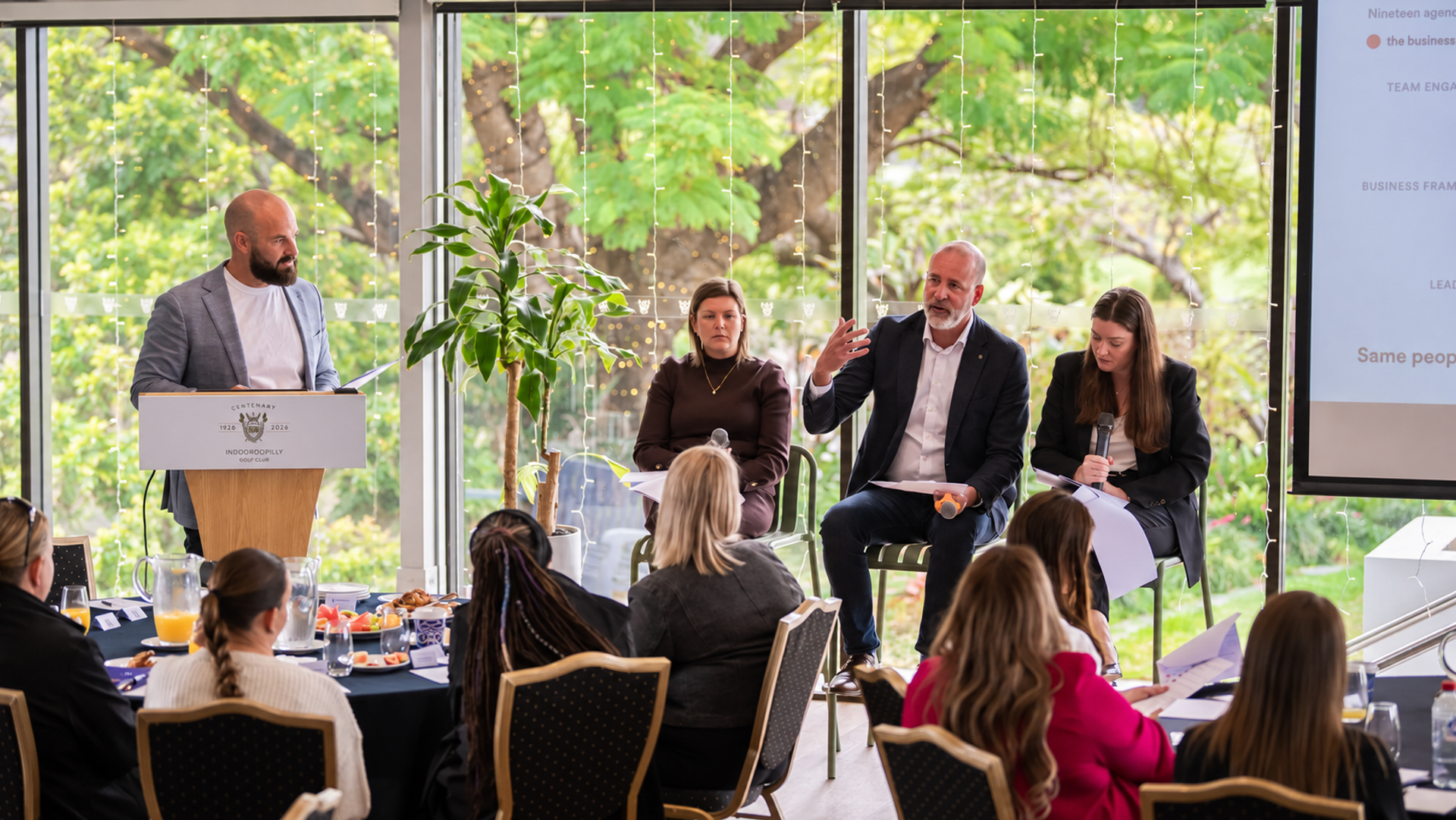
A room full of principals stopped talking about growth and started talking about what was in the way of it

Ailo
17 September 2026
Ask a room of property management leaders what growth means and the first answers are numbers. Ask them again twenty minutes later, once three of their peers have described what growth actually cost their teams before they fixed it, and the answers change.
That is what happened at Indooroopilly Golf Club on Thursday 10 September, the third room in A Working Round Table for Principals and Leadership in Property Management, the series Ailo has been carrying around the country this year.
Adelaide in July, Melbourne in August, Brisbane now, Sydney at the end of the month.
The format is deliberate; round tables, a table captain on each, principals invited alongside their heads of property management, a screen for the data and a roving microphone for the questions. No stage, no demonstration, no pitch.
Every guest arrives to find their own team's culture survey results in an envelope on the table, so the conversation has something to push against from the first minute.
Adelaide in July, Melbourne in August, Brisbane now, Sydney at the end of the month.
The format is deliberate; round tables, a table captain on each, principals invited alongside their heads of property management, a screen for the data and a roving microphone for the questions. No stage, no demonstration, no pitch.
Every guest arrives to find their own team's culture survey results in an envelope on the table, so the conversation has something to push against from the first minute.
The panel was Jodie Stainton, Group and Property Management Director at Harcourts Solutions; Lindsey Burne, franchise owner at LJ Hooker Dickson and chair of the LJ Hooker Franchise Owners Council; and Lisa Hyland from Ray White Canberra.
Three businesses of a similar scale, three different franchise groups, one common decision made in the last couple of years.
Three businesses of a similar scale, three different franchise groups, one common decision made in the last couple of years.
Jodie opened with a definition of growth built on people rather than rent roll.

“"I want a business where people can genuinely say they can become what they want to become in our business. We love people who love property management, and they need careers, not just jobs " ”
— Jodie Stainton, Harcourts Solutions
The numbers came after, and they were considerable, but the line that made people put their pens down was about data. She described arriving at a legacy system as a self-declared data nerd and being unable to answer the most basic question a director gets asked. "I could not work out how many managements we have." She went to board meetings with a figure she could only place within a ten per cent range.
“Everywhere I looked, somewhere the data was wrong." Today she can tell you the count to the property, and her squads, which she was told by half the network could not work, are working. "Squads do work when the systems support it.”
— Jodie Stainton, Harcourts Solutions
Lindsey's register was different. He speaks as an owner with a rent roll that is also his retirement plan, and he was candid about a mistake.
He had once been given an innovation award by a legacy system, and over fifteen years he kept adding the technology those systems put in front of him, every product promising to lift properties per head.
He had once been given an innovation award by a legacy system, and over fifteen years he kept adding the technology those systems put in front of him, every product promising to lift properties per head.

“In 15 years of changing and buying and adding on more stuff, the needle didn't move at all." What it did move was the load. "The property manager sits down at their desk and they've got to open their 12 platforms before they can even start work for the day." Then, quietly: "I thought I was doing the right thing by them, but I wasn't. ”
— Lindsey Burne, Principal LJ Hooker Dickson
You could feel the room recognise itself in that sentence. Every owner in the industry built their stack one well-intentioned subscription at a time, and what was sold as the solution became the problem. His answer was to strip it back to one system, and the transparency that gave him is what changed his team.
Lisa brought the word she has used all year for a business that has completed three acquisitions in four months: calm. Her frame for growth is her people, and her mechanism is a programme she calls Choose Your Own Adventure, where a property manager decides how large a portfolio they want to carry and the business wraps the support around them, from an expected 200 properties through to 250 with a virtual assistant behind them. What struck me was how she described change.

“We don't talk about change fatigue within our business." Her team has stopped hiding behind email, and she said so plainly: "They're not afraid to pick up the phone and call owners anymore.”
— Lisa Hyland, Ray White Canberra
We spent the middle of the morning on the Service Profit Chain, because the survey results in front of every guest were built on it. The leading indicators of a chain that is broken are familiar to anyone who has run a rent roll: workarounds, duplicated entry, cliques forming because communication has failed, a receptionist taking the same message four times in a day. The lagging indicators are the ones that hurt: turnover, burnout, recruitment that never ends. The three panellists' teams had scored high on engagement and alignment. Lindsey has now run the survey twice, and the change between them was the point. Where his team once resented every new management because they were already full, they are now wishing the BDM luck on the way out the door. "I need another one."
The questions from the tables were the evidence that the room had moved. One principal, mid-restructure and unsure whether she had the right people, asked the question of the morning: do you start with the team or with the process? Lisa's answer was to get the people in a room and understand what is actually going on before touching anything. Jodie's was shorter. "Always start with the people." My own was that both of those begin with a vision the team can see themselves in. Another table asked how you measure success when the checklists are gone and the autonomy is real. Lindsey's answer was to put one metric on the screen at each team meeting and watch it. "Whatever we focus on, three weeks later it's better."
The panel described what happened in their businesses when the system stopped being the constraint, and the audience were left to draw their own conclusions, which is the only way a decision like this should be made.
Ailo runs these rooms because peer conversation changes minds in ways a sales pitch never will. The question I left Brisbane with is the one I will carry to Sydney: how much of what your business has labelled a growth problem is actually a systems problem wearing a growth problem's clothes?
The Sydney round table is on Tuesday 29 September. Principals and property management leaders can register here: Sydney Round Table